




 Newsletter

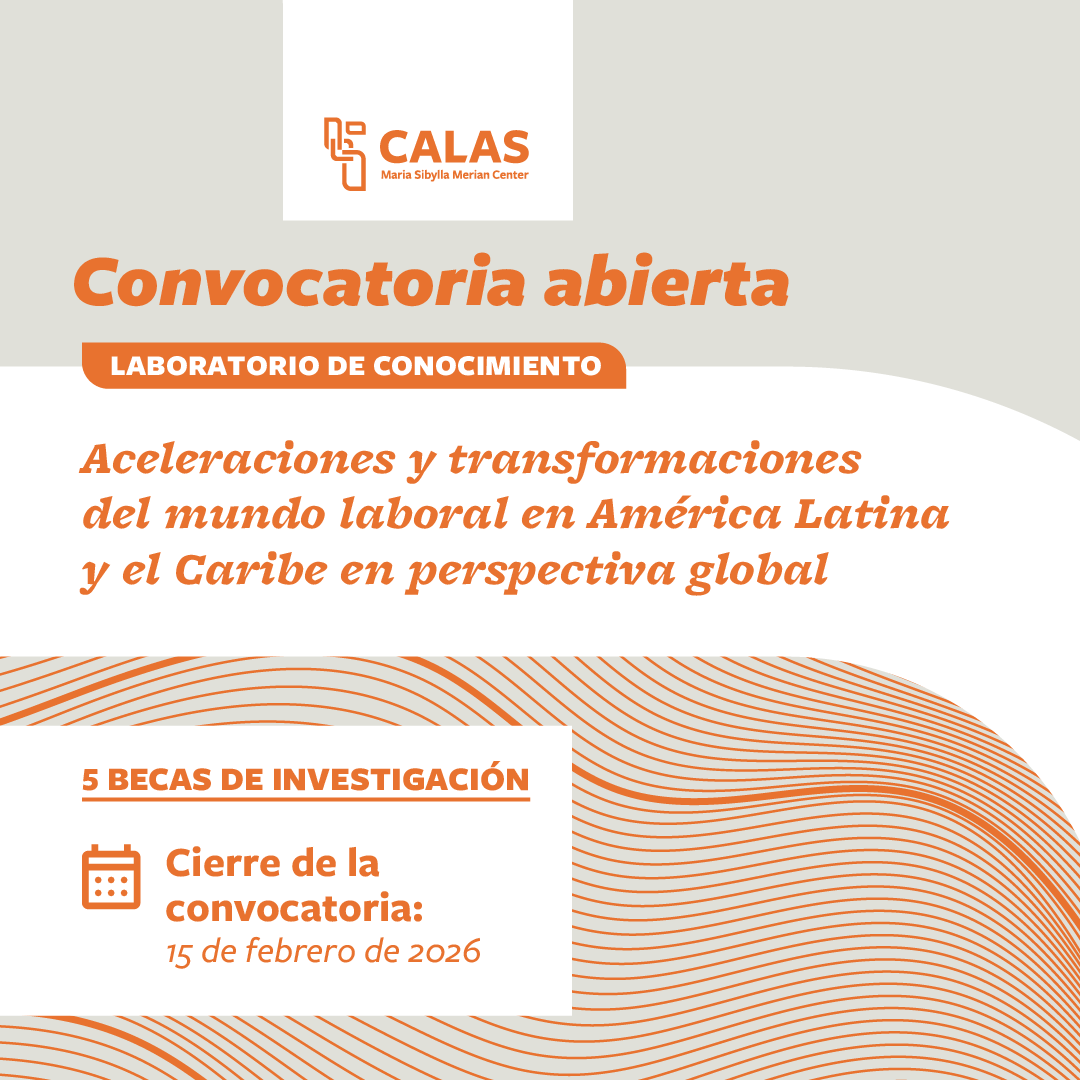
Within the framework of the Knowledge Laboratory “Accelerations and transformations in the world of labor in Latin America and the Caribbean in global perspective,” the Center for Advanced Latin American Studies (CALAS) opens a call for up to 5 research grants lasting three to five months, to be carried out between August and December 2026, at the CALAS headquarters in Guadalajara (Mexico). The Knowledge Laboratory is part of the CALAS Program “Creating Horizons: Accelerations, Transformations, Emergences,” particularly the axis “Transformations”, that focuses on analyzing the global transformation processes that are eroding old certainties and questioning the foundations of our societies, while creating new horizons for shaping current living conditions.
Objective of the Laboratory
The crises currently affecting Latin America and the Caribbean, together with the profound transformations in the world of labor, have become the central stage for debating and redefining the region's model of social cohesion. In this context, regional sociopolitical dynamics take on particular relevance, especially after the strengthening of neoliberal policies that followed a cycle of progressive governments. The current scenario has witnessed how political elites have resorted to what Kittrie (2016) calls “legal warfare,” a mechanism used to reconfigure the world of labor. In most cases, this process has led to a significant setback in workers’ rights, as well as the systematic erosion of social and occupational guarantees. Political elites have used legal mechanisms to reconfigure the world of labor, leading to an erosion of workers' rights and protections and the emergence of a “new social question.”
The Knowledge Laboratory aims to analyze the effects of the neoliberal crisis and of global digitalization on the reconfiguration of the world of labor in Latin America and the Caribbean. To this end, it undertakes a critical examination of the global logic of precarization, the weakening of rights, and the increase in inequalities, as well as the transformations in institutional frameworks, social dynamics, and intersectional relationships. We also want to address alternative worlds of labor based on self-organization, participation, redistribution, and mutual responsibility. Historically, these forms of organization have always existed beyond the state and, today, they are an important source of inspiration for reflecting on other ways of life and work outside of neoliberal capitalism.
Research areas
Based on these approaches, the knowledge laboratory will address four cross-cutting areas of research:
1. Forms of job insecurity, “legal warfare,” erosion of labor rights, and weakening of collective bargaining: This area analyzes forms of job insecurity: informality, temporary jobs, “zero hour” contracts, outsourcing, self-employment, underemployment, unpaid care work, in contrast to an erosion of formal employment, within the neoliberal framework of so-called “labor market flexibility” that generates inequalities based on gender, ethnicity, age, and diversity, resulting in labor segmentation embedded in a dual labor market that generates, on the one hand, dynamic sectors that are highly remunerated and have access to welfare, and on the other, large sectors in precarious and vulnerable conditions.
These changes also encourage forced labor migration, both due to a lack of opportunities and to meet demand in secondary labor markets, characterized by high levels of informality, discrimination, and labor abuse, especially in agriculture, construction, and services. It is also important to learn about the alternatives developed by grassroots economies and popular economies in order to answer questions such as the following: How does the context of changes in the labor market, the erosion of labor rights, the “flexibilization” of employment, and the expansion of marginalization, informality, and poverty—intersected by class, ethnicity, gender, and age—the new dimensions and transformations in inequalities, labor migration, women's work, child labor, the work of young people and older adults, as well as changes in the conception and dynamics of families? How do workers in the traditional sector react to the pressures of the modern sector of the economy? In addition, this axis studies neoliberal reformism applied to the world of labor, through which political elites have promoted the weakening of legal adjustments that undermine labor justice, labor rights, and institutionalized social protection networks. The increase in informality puts pressure on traditional forms of collective representation, making it necessary for grassroots organizations to respond to the changing context in terms of inequalities, the diversification of workers, and the digitization of the global economy.
2. Platform capitalism, digitalization of the economy, and the gig economy: This axis analyzes “uberization” and digital platforms and their impact on the redefinition of employment and job insecurity, which involve changes based on control through algorithms, outside legal protection, with a lack of stability, continuous income, and employment benefits. In a context of “false autonomy,” employees they are linked to companies as “independent” workers but are in fact heavily dependent on the platforms, which also reproduce segmentation by gender, ethnicity, and age, in a context where the relationship between capital and labor is being transformed and “the separation between work and private life is being erased.” (Prix 2022). The technological gap that excludes a large sector of society is widening, making it necessary to think about ways of regulating work through apps geared towards promoting decent work and collective bargaining. It is important to inquire into the following questions: What level of growth has platform capitalism experienced in Latin America and the Caribbean? How do the state, the market, and civil society justify the validity of the transformation of the world of work? And, at the same time, how do workers perceive this transformation, and how do they envision the possibilities of a decent income in the age of bots?
3. Alternative forms of economy: Beyond the analysis of the transformations of the world of labor, characterized by acceleration, digitization, and increasing inequality, this axis proposes to investigate alternative worlds of labor, both historical and current, based on self-organization, participation, redistribution, and mutual responsibility. Throughout the 20th century, alternative economies—from revolutionary experiments, such as popular power in Chile, to initiatives in liberal and neoliberal contexts—have demonstrated their ability to adapt. Today, examples such as coffee cooperatives in fair trade networks or globalized urban recycling organizations reflect their continued relevance. In this context, the communal use of resources (land, water, forests) stands out, a practice with deep roots in Latin American indigenous cultures. During the colonial era, these forms of organization persisted as common goods, but were suppressed after independence by liberal reforms. The Mexican Revolution revived them with agrarian reform based on ejidos, while 19th-century European migration introduced urban and industrial cooperative models, such as mutual aid societies. We will address these forms, both historical and current, from an interdisciplinary approach (anthropological, historical, economic, and cultural), analyzing their functioning, their structures, their challenges (both successes and failures), and their contribution to the resolution of social, economic, and ecological crises. Emphasis will be placed on the role of gender and its potential in the possibility of social transformation based on solidarity and cooperative economies.
4. Social and cultural representations of labor inequalities: This axis addresses the subjectivities, symbolic, discursive, artistic, or media forms that express, reproduce, or criticize structural and everyday differences in the world of work, from above and below, through representations of class, gender, ethnicity, age, and other intersectionalities. These representations can be studied in literature, film, television, music, popular art, social media, the press, testimonies, and political discourse. While some of these representations may legitimize inequalities, it is clear that others allow us to value adaptation, resistance, and the possibilities of generating proposals for change. Artistic perspectives, activism, and feminist perspectives will be considered as bridges between production and reproduction. We are interested in exploring how the trajectories of workers, caregivers, and migrants are re-signified as testimony to inequality. What are the main social representations, stereotypes, and images that naturalize labor inequalities or that denounce their scope and propose alternatives?
Conditions of the scholarship
The call is aimed at outstanding academics with university training in the humanities or social sciences. The minimum academic degree required is a doctorate; in addition, the trajectory and scientific reputation, relevant publications on the proposed topic, experience in the research topic and the quality of the project presented will be evaluated.
CALAS is committed to inclusiveness and the goal of gender parity. It expressly welcomes applications from severely disabled and handicapped persons, duly qualified. The CALAS fellowship program aims for gender parity and promotes affirmative action policies.
Fellows are expected to reside for the duration of the fellowship at the CALAS headquarters in Guadalajara, Mexico and participate in CALAS activities and events organized within the framework of the Knowledge Laboratory. They will have the opportunity to make use of the resources of CALAS and the respective host institutions; the University of Guadalajara, including office space, access to libraries and research facilities.
The scholarship is endowed with a competitive financial award. In the event that the applicant occupies a permanent position, the scholarship can be used to (partially) finance a temporary replacement. In addition, travel costs are covered.
CALAS expects from the fellows the publication of research results to be agreed with the coordinating committee of the Knowledge Laboratory. At the end of the fellowship, fellows are also expected to inform about their activities in a report.
Application
You must complete the online application form and add the following documents in PDF format in Spanish or English language:
- Motivation letter explaining how the project relates to the Laboratory’s research program, what your expectations are, and where you are applying to stay.
- Presentation of an innovative research project with justification of the contribution to the Laboratory, including timeline and work plan, with a maximum of 10 bibliographic sources (max. 5 pages/2,000 words).
- Two-page curriculum vitae with list of relevant publications.
- Copy of doctoral degree.
Important dates:
Closing date: February 15, 2026.
Decision date: April 15, 2026.
Start of the fellowship: between August and December 2026.
Due to the number of applications, rejections cannot be justified.
Scientific direction of the Laboratory:
Dr. Ronny J. Viales Hurtado, Universidad de Costa Rica
Dr. Werner Mackenbach, Universidad de Costa Rica
Dra. Christine Hatzky, Leibniz Universität Hannover, Alemania
Dr. Joachim Michael, Universität Bielefeld, Alemania
Dr. Javier Lastra-Bravo, Leibniz Universität Hannover, Alemania
Dra. Cristina Cielo, FLACSO-Ecuador
Dra. Marina Farinetti, UNSAM-Argentina
Dra. Beatriz Adriana Bustos Torres, UdeG-México
More information:
Maria Sibylla Merian Center for Advanced Latin American Studies, regional site Central America and the Caribbean, tel. +506 2511 3338. E-mail: sedesanjosecalas@gmail.com
