




 Newsletter

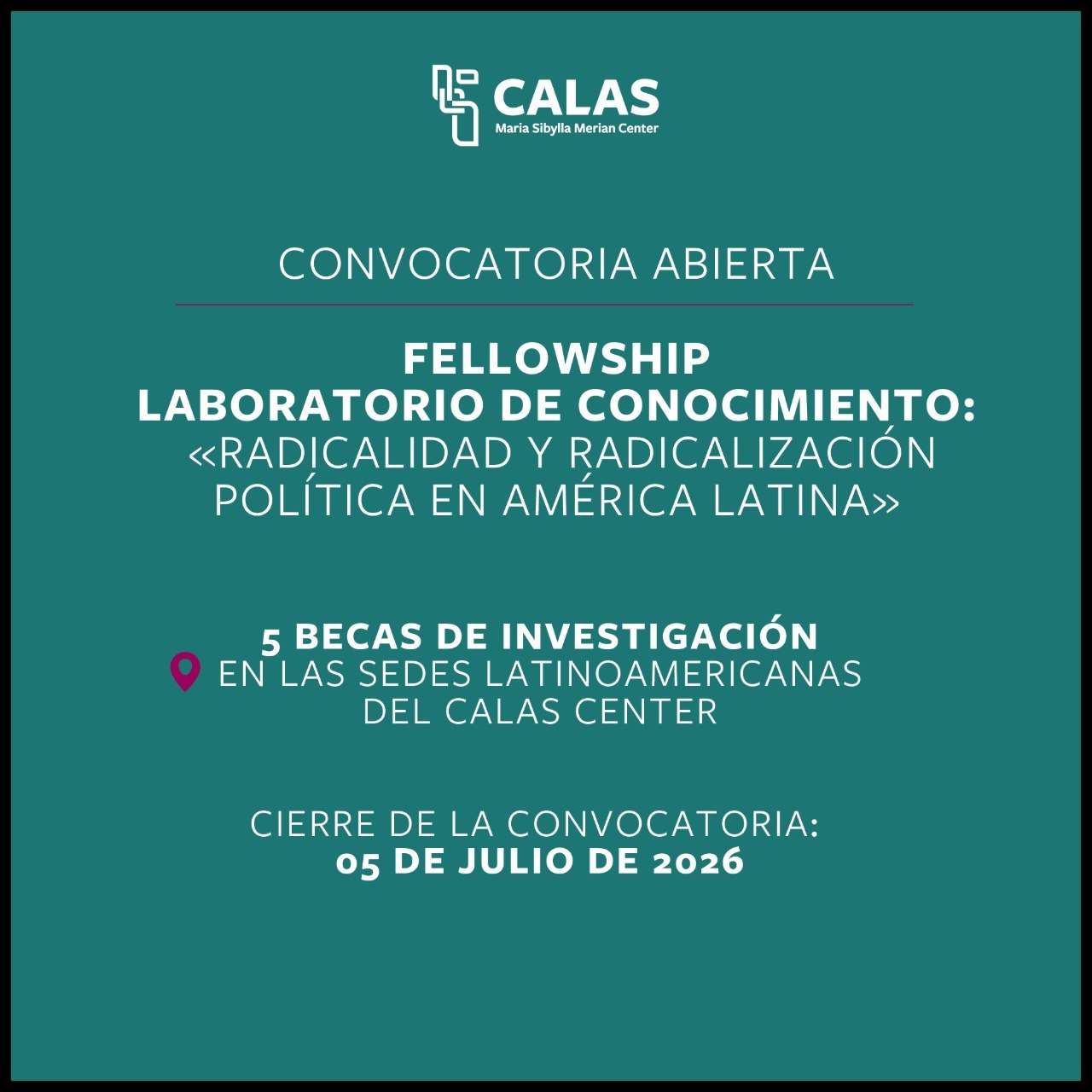
The Maria Sibylla Merian Center for Advanced Latin American Studies (CALAS) is offering up to five research fellowships to be carried out at one of CALAS’s regional offices in Latin America (Guadalajara, Mexico; San José, Costa Rica; Quito, Ecuador; Buenos Aires, Argentina). The fellowships are part of the Knowledge Laboratory “Political Radicalism and Radicalization in Latin America: Democratic Challenges, Differences, and Transformation.” The residencies will last between three and five months, to be carried out between February and June 2027.
Political Radicalism and Global and Regional Authoritarianisms: An Approach
Over the past decade, both globally and regionally, dynamics have intensified that undermine the foundations and legitimacy of democratic pluralism. Rather than isolated phenomena, these processes reflect a reconfiguration of political conflict and public culture that transcends traditional classifications of left and right and compels us to rethink existing conceptual frameworks. In Latin America and the Caribbean, while these trends are intertwined with historical trajectories of persistent inequality, institutional fragility, and recurring cycles of political disaffection, the current moment presents qualitatively distinct features stemming from the convergence of a crisis of representation, socioeconomic precariousness, and the fragmentation of the information ecosystem.
To capture these transformations, the knowledge laboratory proposes situating the analysis on a spectrum whose poles are radicalism—understood as a set of intense ideological positions that can operate within the space of democratic competition—and extremism—understood as a form of anti-pluralist closure that legitimizes the exclusion of the adversary and, in its most acute expressions, political violence. Between these two poles, radicalization operates as a process: a relational, gradual, and multilevel shift through which individual and collective actors intensify anti-pluralist or anti-legalist dispositions, moralize political conflict, and broaden the thresholds of tolerance toward coercion or the exclusion of adversaries. This process allows for trajectories in both directions: toward the pole of extremism, but also in the opposite direction, such as deradicalization and democratic resilience.
Within this framework, the Laboratory’s focus shifts from the description of radical and/or radicalized actors to the analysis of the mechanisms that drive mobility along the spectrum. Radicalism, understood in this way, is not an attribute exclusive to a single ideological family, but rather a mode of structuring conflict that is potentially transversal to different political positions. Thus, the Laboratory’s analytical focus shifts toward understanding the conditions that favor the activation, diffusion, and/or containment of radicalization across multiple fields, rather than the ideological characterization of its bearers.
Across the board, the Laboratory explores the question: How do the processes of political radicalization and polarization in Latin America feed into one another (with potential connections to radicalism in other regions of the world), and under what conditions have the region’s democracies—or have they not—developed effective mechanisms for democratic containment and resilience in recent years? Additionally, we ask: 1) How can we conceptualize these changes without reducing them to isolated episodes or diluting them into overly general categories? 2) To what extent do these processes reflect an intensification of political radicalism, ongoing radicalization, or—in their most acute forms—extremist configurations that erode pluralism from within?
The knowledge laboratory is structured around five thematic axes. These axes do not constitute parallel lines of inquiry but rather interconnected dimensions of the same process of reconfiguration of democratic conflict.
Axis A: Conceptual Framework: Radicalization, Polarization, and Democratic Resilience
This axis will serve a dual function within the Laboratory. On the one hand, it will develop analytical distinctions between radicalism, radicalization, extremism, and polarization, clarifying the conceptual spectrum that serves as a shared framework for the subsequent axes. On the other hand, it will theoretically identify the mechanisms that explain both the escalation toward the pole of extremism and the processes of reversing such dynamics, as well as instances of democratic resilience. In this dual capacity, the axis provides the interpretive framework through which the findings of the subsequent axes are articulated. Rather than establishing rigid typologies, it proposes a relational and process-oriented approach that allows us to observe how these dynamics emerge, intensify, or are contained within specific contexts of political conflict and the transformation of the public sphere.
Axis B: Democratic Challenges I: New Right-Wing Movements
The emergence and consolidation of new right-wing movements constitute one of the most relevant phenomena for the analysis of the dynamics of political radicalization in the region. More than a simple reconfiguration of the conservative camp, these actors express a shift in the discursive, organizational, and programmatic repertoire of the contemporary right, flexibly articulating elements of punitive populism, moral conservatism, nativism, religious appeals, and direct criticism of traditional political elites. The central issue lies not only in their electoral growth, but in their capacity to redefine the frameworks of legitimacy within the democratic conflict, straining principles such as pluralism, the protection of minorities, and the autonomy of institutions. Additionally, and in keeping with the principle of analytical symmetry that guides the Laboratory, this axis also addresses expressions of radicalization present in sectors of the left and among actors situated outside the left-right divide.
Axis C: Democratic Challenges II: Feminisms-Antifeminism
Disputes surrounding gender agendas have become one of the most dynamic arenas for the reconfiguration of political conflict in Latin America. The expansion of feminist movements, particularly over the last decade, has driven far-reaching normative, institutional, and cultural transformations. In response to these advances, anti-feminist counter-mobilizations have emerged that directly challenge the rights frameworks associated with gender equality and diversity and/or the attribution of responsibility for global phenomena such as collapsing birth rates. The central issue lies not only in thematic polarization, but in the way these disputes are progressively reframed in moral and civilizational terms, fostering dynamics of radicalization that go beyond the realm of conventional democratic deliberation. Additionally, this section seeks to examine the conditions under which feminist movements have operated as agents of democratic containment.
Axis D: Democratic Challenges III: Digitalization, Hate Speech, and Changes in Cultural Policy
The accelerated digitalization of the public sphere has profoundly reconfigured the conditions of production, circulation, and validation of political information. Far from being merely a technological shift, the expansion of social media platforms, algorithmic designs, and attention economies has modified the incentives of political communication, favoring the visibility of emotionally intense, morally polarizing, and potentially disinformation-laden content. As a result of the interaction processes between platforms, users, and political contexts, echo chambers and amplification circuits are fostered, reducing exposure to dissent and accelerating processes of affective radicalization. Nevertheless, relevant debates persist regarding the specific causal mechanisms by which exposure to disinformation, hate speech, or segmented communication environments translates, or does not, into anti-pluralist attitudes and politically radicalized behaviors.
Axis E: Democratic Challenges IV: Environment, Climate Denialism, and Environmental Violence Environmental disputes have consolidated as a growing front of political tension in Latin America. The link between extractivism, conflicts, and democratic backsliding constitutes a field of problems in which actors defending resource-intensive development models mobilize repertoires of political radicalization to delegitimize environmental demands and criminalize their spokespeople. Climate denialism and narratives of delegitimization emerge in this scenario as political repertoires that not only challenge scientific diagnoses but also reconfigure the frameworks of legitimacy in public debate. Empirically, these dynamics manifest themselves in the dissemination of discourses that present environmental regulation as a threat to economic growth, national sovereignty, or employment, and in the systematic stigmatization of environmental movements, Indigenous communities, and land defenders.
Scholarship Conditions
The call is aimed at outstanding academics with university training in the humanities or social sciences. The minimum academic degree required is a doctorate; in addition, the trajectory and scientific reputation, relevant publications on the proposed topic, experience in the research topic and the quality of the project presented will be evaluated.
CALAS is committed to inclusiveness and the goal of gender parity. It expressly welcomes applications from severely disabled and handicapped persons, duly qualified. The CALAS fellowship program aims for gender parity and promotes affirmative action policies.
Fellows are expected to reside for the duration of the fellowship at one of the four CALAS regional sites and participate in CALAS activities and events organized within the framework of the Knowledge Laboratory. They will have the opportunity to make use of the resources of CALAS and the respective host institutions; the University of Guadalajara, the University of Costa Rica, FLACSO Ecuador and the National University of San Martin, including office space, access to libraries and research facilities.
The scholarship is endowed with a competitive financial award. In the event that the applicant occupies a permanent position, the scholarship can be used to (partially) finance a temporary replacement. In addition, travel costs are covered.
CALAS expects from the fellows the publication of research results to be agreed with the coordinating committee of the Knowledge Laboratory. At the end of the fellowship, fellows are also expected to inform about their activities in a report.
Application
Please complete the online application form and add the following documents in PDF format in Spanish or English language:
- Motivation letter explaining how the project relates to the Laboratory’s research program, what your expectations are, and where you are applying to stay.
- Presentation of an innovative research project, justifying its contribution to the debate on political radicalism and radicalization in Latin America, including a timeline and work plan, with a maximum of 10 bibliographic sources (max. 5 pages/2,000 words). An explicit justification of the research area to which the project aims to contribute is expected.
- Two-page curriculum vitae with list of relevant publications.
- Copy of doctoral degree.
Important dates:
Closing date: July 5, 2026.
Decision date: September 15, 2026.
Start of the scholarship: between February and April 2027.
Due to the number of applications, rejections cannot be justified.
Scientific coordination of the Knowledge Laboratory:
- Kristina Dietz (Kassel University)
- Pablo Cabrera Barona (FLACSO Ecuador)
- Juan Federico Pino Uribe (FLACSO Ecuador)
- Lucas Christel (UNSAM)
- Adriana Petra (UNSAM)
- Brenda Focas (UNSAM)
More information: merian.calas@gmail.com
