




 Newsletter

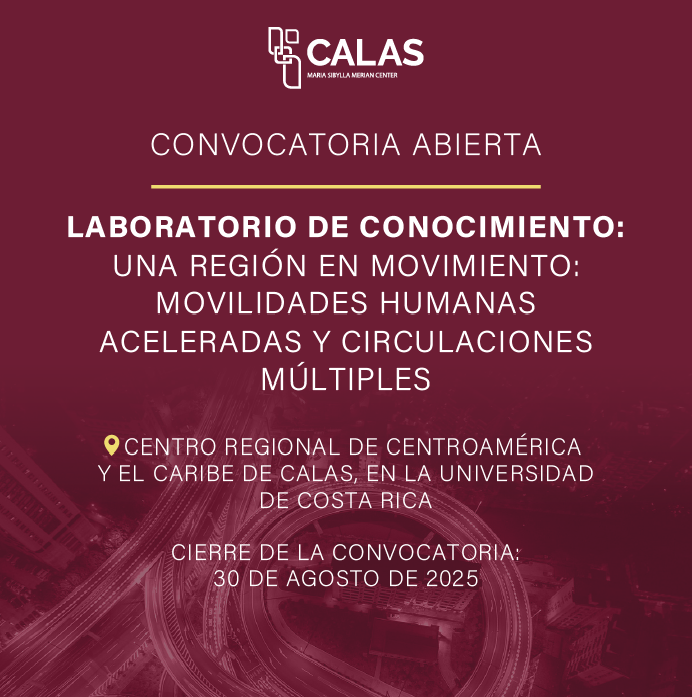
The Knowledge Laboratory “A Region on the Move: Accelerated Human Mobilities and Multiple Circulations in Latin America and the Caribbean”, of the Center for Advanced Latin American Studies (CALAS), invites researchers to participate in the International Conference to be held from September 7 to 9, 2026, at the University of Costa Rica.
Human mobility appears as one of the defining characteristics of the accelerating dynamics of modern social processes. Circulations are multiple and involve the mobility of people as well as the flow of goods, materials, ideas, and knowledge. These processes result in unequal exchanges among people, places, groups, and cultures interacting with non-human elements. They trigger processes of social, cultural, and scientific transformation by promoting the diffusion of new perspectives, the creation of shared knowledge, and mutual enrichment. Such rearticulations occur in (inter)contexts and can be understood as intercultural processes shaped by dominant ideologies, exclusionary styles of economic growth, and the legitimization of inequalities, but also by transformations in transnational citizenship and expectations about possible futures.
Studying repressive state policies and other forms of violence directed against migrants is essential, but so are alternative proposals and practices related to respecting migrants’ human rights. In addition, it is necessary to consider the migration of elites and the creation of new spaces “from above,” which also promote the circulation of ideas, centered on actors such as “digital nomads” and their impact on processes of gentrification.
Migration is also cultural. Through diverse migratory movements, cultures experience processes of displacement and transformation. Space can no longer be seen merely as the setting in which migrations and circulations occur; rather, attention must be paid to the transformations that various mobilities impose on it in terms of political, social, and cultural perceptions. According to the spatial turn, space is not only the background in which phenomena are rooted and actions take place. To a large extent, space is shaped by sociocultural conditions and also contributes substantially to the production of culture and society.
The conference proposes to discuss these phenomena primarily in the present context of Latin America and the Caribbean, but it is also interested in mobilities and transformative social and cultural processes in the past.
Research Axes
Based on these considerations, the conference proposes four cross-cutting research axes:
1. Human mobility, circulation of ideas, and new meaning-making practices – transnational cultures and global political cultures
Today, every culture tends to be conceived as transnational in light of intercultural dynamics promoted by the movement of ideas, concepts, imaginaries, styles, practices, affects, and attitudes. In this sense, it is also important to ask to what extent politics is subject to circulation and to what extent it attempts to control mobilities. What are the dominant narratives about processes of (de)globalization and the movement of people? How have transnational cultures been strengthened, and how have forms of coexistence based on flexible citizenships been eroded? Which ideas and imaginaries circulate—from above and from below—regarding mobility and the circulation of ideas? Which circulating objects and symbols articulate subjectivities around transnational cultures?
2. Space in motion: mobility and the reconfiguration of space as well as the creation of new spaces
This axis seeks to address the effects of the movement of people and objects on space and on perceptions of space. As mobility expands and multiplies relationships between places and positions, spatial configurations and representations are altered. The aim is to consider spatiality as a social and historical construction in its three dimensions: physical space, lived space, and imagined space. What is the relationship between imaginaries and the symbolic construction of new transnational spaces? How are conceptual spaces articulated in the perception of lived spaces?
3. New forms of (dis)integration, (in)equality, and social cohesion in processes of accelerated mobility and multiple circulation
Social disintegration—related in multiple ways to processes of mobility and circulation—refers to the collapse of structures, values, norms, and social relationships that form the basis of societies. However, it also generates new values and new forms of cohesion that likewise arise from mobility and circulation processes. In this context, how might human and digital mobilities lead to new perspectives of economic and social mobility that help restore paths toward equality?
4. Mobility and acceleration in the labor sphere and the new social question
The rise of platform capitalism has intensified the circulation of ideas, knowledge, forms of work, and rights to the use of goods and services in increasingly interconnected markets. In this context, how does the acceleration imposed by capitalism affect trajectories of labor and social mobility in Latin America and the Caribbean, and what policies could reverse the precarization of independent work in order to restore expectations of social advancement?
Application Conditions
- The call is directed at applicants from the Social Sciences and Humanities who can contribute to the themes presented, both empirically and theoretically or methodologically.
- Applicants must complete the application form with the title and abstract of the proposal and a brief academic profile including professional trajectory and relevant publications.
- Languages: English and Spanish
- Deadline: May 3, 2026
An academic committee will select the papers based on criteria of excellence. Applicants will be notified before June 15, 2026 regarding the decision about their proposal. CALAS will cover accommodation and meals, and there will also be a limited budget for travel expenses.
Further Information
Maria Sibylla Merian Center for Advanced Latin American Studies (CALAS)
Regional Office for Central America and the Caribbean, University of Costa Rica
Tel: +506 2511 3338
Email: sedesanjosecalas@gmail.com
