




 Newsletter

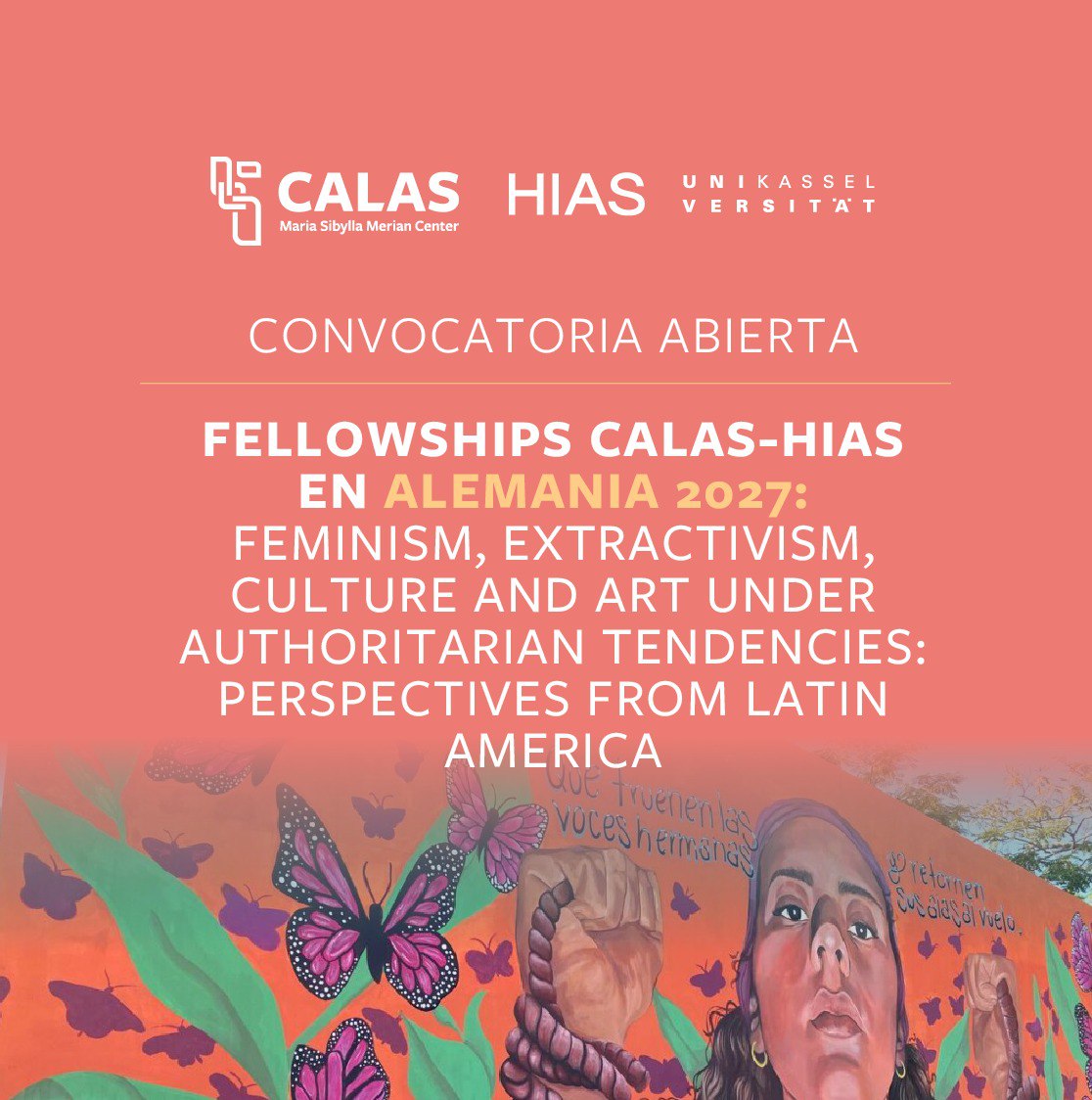
The Maria Sibylla Merian Center for Advanced Latin American Studies in the Humanities and Social Sciences (CALAS) and the Hamburg Institute for Advanced Study (HIAS) invite outstanding scholars from Latin America and the Caribbean to undertake research projects for a total of six months—four months in Hamburg and two months at the University of Kassel, Germany.
This year’s fellowship focuses on contemporary authoritarian backlashes in Latin America. As in other world regions and against the backdrop of the rise of the far-right, anti-democratic political forces, achievements in the areas of democratic pluralism, cultural diversity, aesthetics and arts, gender equality and diversity as well as environmental rights and norms are currently under threat in Latin America. These developments are particularly felt in the areas of gender, the environment culture and arts. They are accompanied by the normalization of anti-feminist rhetoric and policies, including attacks on reproductive rights and gender equality; the deepening of extractivist economies (mining, agribusiness, fossil fuels) often justified through nationalist or “developmentalist” narratives; the erosion of environmental protections and the criminalization of environmental defenders, cultural regression and the emergence of new aesthetics.
Disputes surrounding gender, cultural and gender diversity have become one of the most dynamic areas of political conflict reconfiguration in Latin America. The expansion of feminist and LGBTQ+ movements have been accompanied by the emergence of anti-feminist counter-mobilizations and campaigns against so-called “gender ideology” that directly challenge legal and social frameworks promoting gender equality and diversity. Similarly, disputes surrounding the environmental agenda have also become a growing source of political tension in Latin America, in a context marked by intensifying socio-environmental conflicts, the expansion of extractive economies, and the increasing public visibility of the climate crisis. At the same time authoritarian and ultra-liberal tendencies have led to an accelerated struggle over information and knowledge, the rise of hate speech and a (political) culture of distrust, individualisation and fear. Cultural regressions are also felt in attacks on art and artistic expressions as well as in the emergence of new aesthetics of power and domination.
These controversies have taken on a structuring dimension of democratic and social conflict, insofar as they challenge models of development, property regimes, territorial rights, and forms of relationship between the state, the market, and society. Struggles over the rights to land, territories, and ecosystems intersect with gender and cultural disputes and practices, which contest rights over bodies, social identities, and social and cultural and artistic norms, imaginaries, narratives and aesthetics. Together, they reveal a shared underlying struggle over the control of both natural, social and cultural and art worlds, and over who holds the authority to define rights, the democratic agenda and determine the conditions of social and ecological reproduction.
We invite outstanding scholars to critically engage with these dynamics by focusing at one of the following three thematic dimensions. Proposals that establish connections between at least two dimensions are particularly welcome:
1. Feminism and Authoritarianism
- How is the attack on feminism being weaponized to justify repression, control, and the rollback of rights?
- How do movements react to counter the attacks?
This dimension investigates the strategic use of anti-feminist rhetoric—from the myth of the “gender ideology” to the criminalization of abortion and LGBTQ+ rights—as a central pillar of authoritarian projects. It explores how patriarchal and heteronormative norms are being institutionalized through law, education, media, and digital platforms. Further we welcome research on the gendered impacts of authoritarianism, the intersection with anti-environmentalism, and anti-Indigenous positions, and the cultural and political resistance of feminist, Indigenous, and LGBTQ+ movements. We therefore also welcome research on emancipatory practices, and solidarity networks of social reproduction that challenge patriarchal and authoritarian power.
2. Extractivism and authoritarianism
- What is the role of extractivism in authoritarian changes?
- What alternatives emerge and from where?
- What alternative strategies are emancipatory socio-ecological movements developing to counter authoritarian policies, and how effective have these proposals been?
This dimension analyzes the centrality of extractivism in authoritarian developments in Latin America. It examines how climate denialism, the delegitimisation of environmentalism and the intensification of extractivism are linked to authoritarian projects and how ecological destruction is justified through nationalist goals, security discourses, or “economic necessity”. We seek research on the interconnections between extractivism and authoritarianism, as well as on emancipatory alternatives rooted in critical theory, feminist, and Indigenous epistemologies, and community-led resistance. The focus is on transformative visions of sustainability, justice, and socio-ecological reproduction.
3. Culture, art and regression
- In what ways are culture and aesthetics instrumentalized as a tool of power and control to legitimize authoritarian orders in Latin America?
- How can artistic, aesthetical and cultural practices function as forms of political resistance that challenge the authoritarian reconfiguration of public culture?
This dimension examines the impacts of discourses of hate (hate speech), forms of cultural exclusion, the digitalization of information and knowledge, the denial of scientific knowledge, increasing populism and verbal violence on cultural norms and practices as well as on art and aesthetics. We seek research on the interconnections between culture, art and authoritarianism, as well as on emancipatory alternatives rooted in countercultures, alternative aesthetics and artistic expressions.
GENERAL CONDITIONS OF THE FELLOWSHIP:
The Fellow is offered excellent conditions in an inspiring academic and artistic environment. There are numerous opportunities for cross-disciplinary and intersectional collaborations among fellows, researchers, and artists from HIAS member institutions in Hamburg and the CALAS/CELA network in Kassel.
Eligible candidates include researchers from all disciplines and career stages from the postdoctoral level onward, as well as outstanding artists and cultural professionals from all Latin American and Caribbean countries. Disciplines range from political economy, social sciences, and humanities to languages and the arts.
Applicants should have international visibility in their respective fields, along with demonstrated creativity and originality. They must have relevant publications related to the topic of the call and their proposed project. Additionally, the fellow is expected to actively participate in a dynamic community of scholars, scientists, artists and cultural professionals by contributing to conferences and public events. A strong command of written and spoken English and Spanish is essential.
The CALAS/HIAS fellowship offers a competitively remunerated scholarship for a stay of four months at HIAS in Hamburg (February to May 2027) and two months at the University of Kassel (June and July 2027). This grant includes a monthly stipend, the costs of visa, accommodation, health insurance, work materials, and other expenses. If an applicant has a permanent position, the grant can be used to finance a temporary teaching replacement. Additionally, the fellowship will cover the costs of the airfare to and from Germany.
The fellow is expected to reside in Hamburg and Kassel for the whole duration of the fellowship and to participate in the activities and events organized by the respective institution.
During the stay, HIAS and the University of Kassel will provide the Visiting Fellow with a workplace with internet access, as well as the infrastructure of the university (library, etc.). Additionally, they will receive support in finding accommodation, completing bureaucratic formalities on site, obtaining the required visa, etc.
CALAS/HIAS are committed to inclusion and the goal of gender parity. Applications from academics with special needs are expressly welcome. CALAS/HIAS also welcomes fellows who are accompanied by children and family during their stay.
Planned tasks for the CALAS/HIAS fellowship in Hamburg and Kassel
- Develop a research project aligned with the fellowship’s call, intersecting at least two of its thematic dimensions.
- Publish the research findings in one or more scientific articles.
- Teach a two-month concentrated course at the undergraduate or master's level in Social Sciences at the University of Kassel (in German or English).
- Conduct at least one public academic activity (lecture or conference) at each host institution during the fellowship period.
- Prepare a final 5-pages report summarizing all activities carried out during the tenure of the fellowship.
Application Process
Complete the online application form and add the following documents in English as pdf files:
- Cover letter, which should address the following points:
- How the project fits into the CALAS/HIAS fellowship
- What are your expectations undertaking the proyect.
- Brief information on how the project matches with research activities at one of the nine HIAS member institutions in Hamburg (https://hias-hamburg.de/en/about-us/members/).
- Name an academic cooperation partner in Hamburg with whom you already have collaboration or with whom you would like to start collaboration. Not having a cooperation partner in Hamburg yet will not have a negative impact on your application.[1] HIAS will support you in connecting with local researchers once your application has been successful.
- Short statement on how your research project would benefit from the interdisciplinary exchange with the multi-disciplinary fellow group at HIAS.
- Two-page Curriculum Vitae with a list of max. 15 relevant publications and courses taught in English and/or German.
- Summary of the research project, including a timeline and work plan (max. 2,000 words). The proposed project establishes new perspectives/ways of thinking and shows potential for connections with other disciplines.
- Interdisciplinary course for Kassel: (max.1 page with title and a brief course description -200 words) to be taught at Kassel University (English or German).
- Copy of doctoral degree certificate:
Key Dates
- Application deadline: 24 May 2026
- Selection results: 15 July 2026
- Fellowship start date: February 1, 2027 (February to May in Hamburg; June to July in Kassel)
Further information on the CALAS/HIAS fellowship:
For further inquiries, please use the following address: uk106991@uni-kassel.de
[1] Please do not contact researchers solely for the purpose of applying.
